
Ball Sort Puzzle - Color Game
Guru Puzzle GamePuzzle
4.912.05K Reviews
- Version
- 5.9.0
- Installs
- 50.00M
- Age Rating
- Everyone
Screenshots
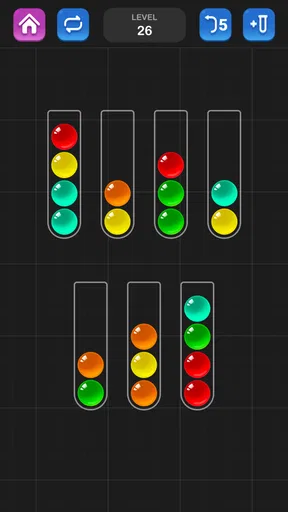
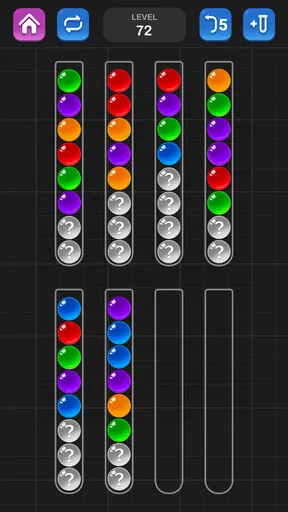
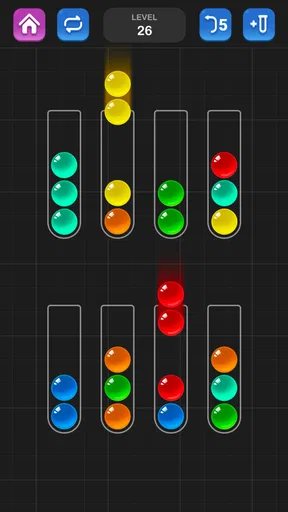
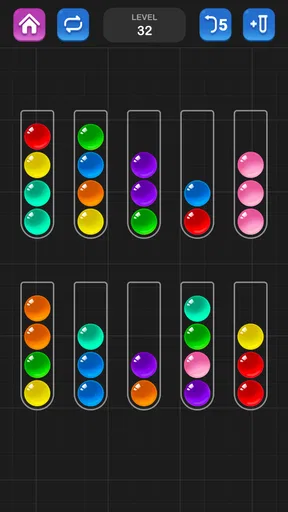
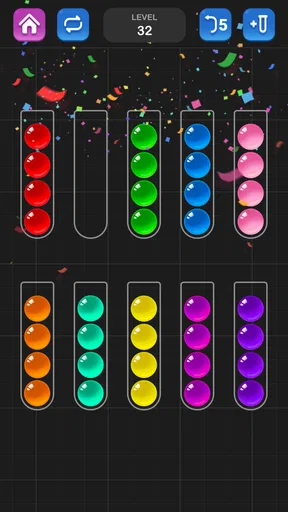
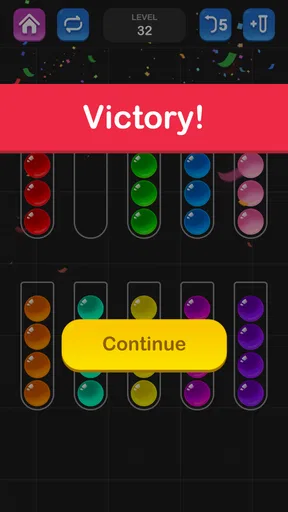
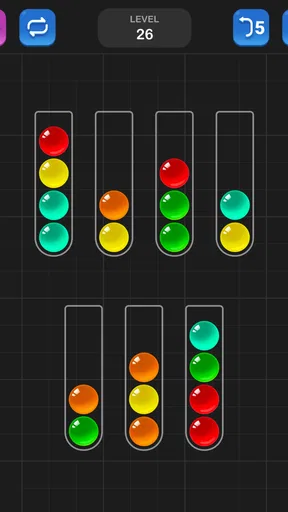
Our Review of Ball Sort Puzzle - Color Game
 Analysis by Appyee
I spent time with Ball Sort Puzzle - Color Game as a quiet, pick-up-and-play puzzle rather than something designed to keep me constantly busy. Its central idea is easy to understand: colored balls need to be arranged into matching tubes, and each move has to be planned around the limited space available. That simplicity is exactly what makes it appealing. I can begin a level almost immediately, but solving it well still demands patience, forward thinking, and the willingness to undo a rushed decision.
This is a free puzzle game from Guru Puzzle Game, aimed at Everyone and available for devices running Android 7.0 or later. It has attracted over 50 million installs and holds a 4.9 average from around 930 thousand ratings, which gives a useful sense of its broad appeal without telling me whether every player will enjoy its particular rhythm. I found it best suited to short breaks, although some levels can easily turn a five-minute session into a much longer attempt.
How the sorting works and why the simple rules stay interesting
Each puzzle presents tubes filled with different colors. The goal is to gather identical colors together, while respecting the basic restriction that a ball can only be moved onto the same color or into an empty tube. The tube capacity is what creates the challenge. A move that looks helpful now can block the color I need two steps later, so the game rewards preparation more than speed.
At first, I naturally focused on making obvious matches. That works for the early learning curve, but it is not enough once several colors are layered over one another. The more reliable approach is to look for a color that is buried and identify which top balls must be moved before it becomes accessible. Empty tubes should be treated as working space, not as convenient storage. Filling one too early can remove the flexibility needed to recover from a poor sequence.
One practical habit made a noticeable difference: before touching the screen, I scanned the top ball of every tube and mentally marked which colors had a clear destination. I then looked for moves that opened a tube rather than merely completed a pair. This changes the game from casual matching into a small planning exercise. It also reduces the feeling that a difficult board is random or unfair, because most failures came from using space carelessly rather than from not knowing the rules.
The controls are deliberately uncomplicated. I tap a tube to pick up its available top color and tap another tube to place it. That makes the game approachable for people who do not usually play puzzle games, and it also means mistakes are easy to understand. The downside is that the interaction itself offers little variety. Players looking for gestures, character progression, story scenes, or several puzzle modes may find the experience narrow.
Progress feels personal rather than competitive
The satisfaction here comes from solving a board that initially looks tangled. I do not need a fast reaction time, and I am not pushed to memorize complicated rules. A good solution usually arrives after I stop making moves automatically and start protecting future options. For me, that made the game useful during moments when I wanted something mentally active but not emotionally intense.
A realistic everyday use is a commute or a short wait at an appointment. I can play one board, put the phone away, and return later without needing to remember a story or a complicated control scheme. It also works well before bed if I choose not to chase a stubborn puzzle for too long. The same feature can become a weakness, though: because the rules are so familiar, repeated sessions may start to feel similar if I want a strong sense of novelty.
The game is also a reasonable choice for someone introducing a child or an older relative to mobile puzzles, especially because its content rating is Everyone and the objective can be explained in a few seconds. I would still sit with a younger player at first, not because the concept is difficult, but because planning several moves ahead can be frustrating when a board appears to have no obvious answer. The game teaches through repetition, yet it does not replace patient guidance.
Where pressure enters the experience
The main pressure is self-created. I want to finish a board without wasting space or backing out of a move, and that can make a simple puzzle unexpectedly absorbing. When I reach a dead end, the frustration comes from recognizing that an earlier choice caused the problem. That is a more thoughtful kind of difficulty than a timer, but it may not suit players who prefer relaxed play with no possibility of having to reconsider a long sequence.
Free access makes the first decision easy: there is no purchase required to try the game. The listed in-app purchase price is $7.99 per item, so anyone considering spending should check the purchase prompt carefully and decide whether the offered item genuinely improves their experience. I treat the free entry point as the strongest reason to test it, while the paid option deserves a more deliberate decision because a single item is not a small impulse purchase for every player.
I also prefer to separate enjoyment from spending pressure. A puzzle can be satisfying without asking me to buy anything, and that is how I approached this one. If a player dislikes seeing purchase options in free games, that may be a reason to skip it even if the sorting itself is enjoyable. On the other hand, someone comfortable with optional mobile purchases can simply play first and decide later, rather than paying before learning whether the level design holds their attention.
The game’s offline play is especially useful for people who want a distraction without depending on a connection. I could imagine using it on a flight, in a basement waiting room, or during a commute where service is unreliable. Offline access also changes the mood: the game feels more like a private puzzle book than a social platform. For me, that is a genuine strength, although it also means there is less of a shared event around each solved board.
Fairness when there is no need to compete
Ball sorting is naturally more personal than competitive. I am measuring progress against my own ability to plan, not against another player’s reaction speed or spending power. That makes the experience feel fair in a way that many competitive mobile games do not. A player who pays for an item is not automatically more skilled at arranging the colors, and a player who never spends can still engage with the core puzzle.
That distinction matters if you are choosing between this and a match-three game built around rankings, timed events, or multiplayer pressure. Those alternatives may provide more excitement and variety, but they can also make performance feel connected to boosters, energy systems, or time limits. This game’s appeal is the opposite: I can take a board at my own pace and focus on the logic of the arrangement.
There is a trade-off in that calm design. Without a strong competitive layer, I do not get the excitement of comparing a score with friends or chasing a live leaderboard. If social recognition is what keeps you playing, a competitive puzzle app may be a better fit. If you want a clean solo challenge that does not require coordination with anyone else, the absence of competition is one of its best qualities.
My most useful fairness tip is to judge a level by the options it leaves open, not by how many matching colors it completes immediately. Completing a tube can feel like progress, but it may also remove a buffer. I found that preserving at least one flexible space for as long as possible made difficult boards more manageable. This is not a flashy feature; it is the strategic habit that most improves the experience.
What I would want to know before installing
The current version is 5.3.0, and the game is free to download. Those details make it straightforward to try on a compatible device, but they do not tell me how every future update will affect the experience. I would install it if I wanted a low-commitment puzzle and had Android 7.0 or newer, while iPhone and iPad users should use the appropriate iOS download offered by the catalog rather than assuming Android requirements apply to their device.
One question many players will have is whether the game is suitable for quick sessions. In my experience, yes, because the basic action is immediate and a board can be approached in small bursts. The more important question is whether you can stop easily. I found that a nearly solved puzzle often encouraged “one more attempt,” so people who are trying to limit screen time should set their own stopping point before beginning a difficult board.
Another likely concern is whether it requires an internet connection. The store summary specifically presents offline play as part of the experience, so it is a sensible choice for disconnected moments. I would still avoid treating offline availability as a promise that every account, update, or purchase-related action behaves identically without a connection. For ordinary puzzle sessions, however, offline use is one of the clearest practical reasons to choose it.
Players may also wonder whether the game is appropriate for children. Its Everyone rating makes it broadly accessible, and the color-based rules are easy to demonstrate. The challenge is cognitive rather than physical: children who enjoy arranging and sorting may find it rewarding, while those who expect constant animation or rapid rewards may lose interest. I would describe it as a calm logic activity, not as an action game disguised as a puzzle.
The final question is whether it is worth paying for an item. My answer is cautious: play the free version long enough to decide whether the core sorting loop remains enjoyable. Since the listed price is $7.99 per item, I would not buy anything simply to solve a single frustrating board. Spending makes more sense only when the game already fits your routine and the particular purchase has a clear value for your own use.
How it compares with familiar puzzle alternatives
Compared with match-three games, this offers less visual spectacle and less moment-to-moment excitement, but it gives me more control over the reasoning. Match-three play often rewards quick pattern recognition and chain reactions. Here, the important skill is sequencing: which tube should be opened, which color should remain available, and when an empty space should be used. I prefer this when I want to think quietly rather than react quickly.
Compared with Sudoku, the sorting game is easier to enter because I do not need to understand rows, columns, or number relationships. Sudoku usually provides a more formal logic structure, while this game communicates everything through color and space. I would choose Sudoku for a deeper, more abstract challenge and Ball Sort Puzzle for a lighter session that still asks me to plan ahead.
Compared with word puzzles, it avoids language dependence. That makes it more accessible across languages and useful for players who want a visual task. The trade-off is that it does not exercise vocabulary or spelling, and its boards can begin to feel familiar once the sorting pattern is fully understood. Its strength is focused spatial planning, not broad mental variety.
I would also distinguish it from games that advertise themselves as brain training through many different activities. This title concentrates on one mechanic, which makes it easier to learn and harder to misunderstand. It is not the best choice if you want a daily program covering memory, arithmetic, language, and reaction exercises. It is a better choice if you know that arranging colors in constrained spaces is the exact kind of small challenge you enjoy.
My trust verdict after weighing the trade-offs
Guru Puzzle Game has built a very accessible puzzle around a small set of rules, and the large audience—over 50 million installs, with around 11 thousand written reviews—suggests that the format has reached far beyond dedicated puzzle fans. I would not treat popularity as proof that every board or purchase decision will suit me, but it does indicate that the game is easy for many people to pick up.
My recommendation is strongest for solo players who want offline access, simple controls, and puzzles that reward careful planning rather than speed. It is also a good fit for a short mental break, a quiet travel companion, or a visual logic activity that can be explained quickly to another person. The free starting point lowers the risk of trying it, while the Everyone rating makes it broadly approachable.
I would skip it if I need a story, multiplayer competition, constant novelty, or a wide range of puzzle types. I would also be cautious if I am easily drawn into repeated attempts or uncomfortable with optional purchase prompts in a free game. The $7.99-per-item purchase point means I would keep spending separate from the basic test: first decide whether the sorting itself is enjoyable, then consider whether any item is worth that cost.
After playing, my honest view is that its appeal comes from restraint. It does not need a complicated setting to make me think; it uses colored balls, limited tube space, and the consequences of each move. The fairest way to approach it is as a free, offline logic pastime—not as a competitive game where spending should determine progress. If that sounds like the kind of challenge you want, it is an easy recommendation to try. If you need more variety or social energy, a different puzzle category will probably keep you interested for longer.
Privacy and Permissions
See what permissions an app requests and how it handles your data.
- Wi-Fi connection information
- view Wi-Fi connections
- Other
- view network connections, full network access, run at startup, control vibration, prevent device from sleeping, read Google service configuration
Verdict
Strengths of Ball Sort Puzzle - Color Game
- Simple drag-and-drop controls are easy for players of all ages.
- Short levels make it convenient for quick breaks or casual play.
- Colorful visuals make the tubes and balls easy to distinguish.
- Increasing difficulty provides a steady challenge as levels progress.
- Offline play is useful when you have no internet connection.
Limitations of Ball Sort Puzzle - Color Game
- Some levels may feel repetitive after extended play sessions.
- Undo options or extra tubes may be limited without watching ads.
- Frequent advertisements can interrupt the flow between puzzles.
- Color-only sorting may be difficult for players with color vision issues.
- Later puzzles can require trial and error rather than pure deduction.
Other Releases by Guru Puzzle Game
View All
Water Sort Puzzle - Sort Color
Puzzle4.8


Differences - Find & Spot It
Puzzle4.9

Goods Puzzle: 3D Sorting Games
Puzzle4.9
Similar Picks in This Category
View All
Block Blast!
HungryStudio4.8

Braindom: Brain Games Test
Lahana Game Studio4.6

AMAZE!
CrazyLabs LTD4.6

Sudoku - Classic Sudoku Puzzle
Oakever Games4.7

Art Puzzle - Puzzle Games
Easybrain4.8

Amaze GO!
Oakever Games4.9
Frequently Asked Questions
What is Ball Sort Puzzle - Color Game?
Ball Sort Puzzle - Color Game is a casual logic game in which you organize colored balls inside tubes until every tube contains balls of only one color. The rules are simple, but later levels require careful planning because tubes have limited space and each move can affect your options. It is designed for short sessions and does not require fast reflexes.
How do you play Ball Sort Puzzle - Color Game?
To play, tap one tube to select the top ball and then tap another tube to move it. A ball can usually be placed only on a matching color or in an empty tube, and the destination must have enough room. The objective is to separate all colors into completed tubes. Undo, restart, or extra-tube options may help when a puzzle becomes difficult.
Is Ball Sort Puzzle - Color Game free to download and play?
The game is generally available as a free download, allowing players to begin solving puzzles without purchasing it upfront. However, free versions commonly include advertisements and may offer optional in-app purchases, such as removing ads, receiving hints, or unlocking additional tools. Before downloading, check the current store listing for the exact pricing and purchase details on your device.
Does Ball Sort Puzzle - Color Game work offline?
Many of the core sorting puzzles can be played without a continuous internet connection, which makes the game convenient for travel, waiting rooms, or quick breaks. Internet access may still be required for advertisements, cloud features, analytics, updates, or purchases. Offline availability can vary between versions, so it is best to test the installed app after its first launch.
Is Ball Sort Puzzle - Color Game suitable for children and casual players?
The game is easy to understand and generally suitable for casual players because it relies on color recognition, logical thinking, and patience rather than complex controls. Younger children may enjoy the simple mechanics, although advertising, optional purchases, and increasingly challenging levels should be reviewed by a parent. Players with color-vision difficulties may also find some color combinations harder to distinguish.
Play our best games!


